Why Paint So Big?
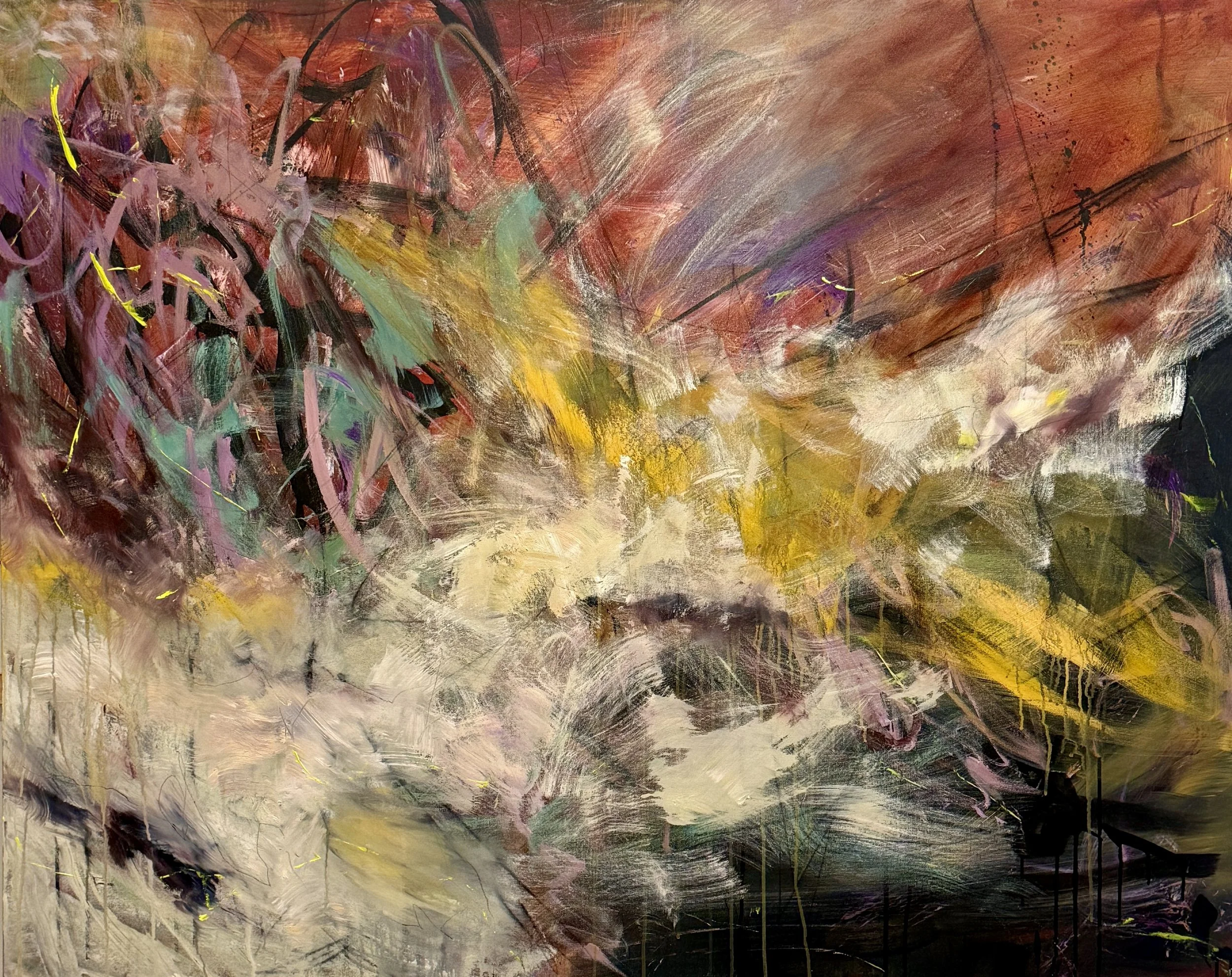
Untitled, 2026, mixed media on canvas
Why paint so big? What’s the point?
This is not a logistical question.
It’s a trajectory question.
First, I used to paint this large back in my college days. It was nothing to do 5 ft., 6 ft., and 7ft. paintings. One of my favorites I ever did was a 7-foot horizontal painting of an abstract nude woman. It commanded the room.
Given where I am in my evolution — In the Gloaming → Grit & Beauty → Tonglen → Submerged → Whitman / Emotional Weather — scale is not decoration. It’s structural. And feels like a returning back to my roots in some ways - a full circle.
Here are the real reasons large paintings matter in my specific context:
1. Scale Changes the Viewer’s Body
Small works are seen.
Large works are entered.
When you move to 60x72, 72x90, or a triptych, the painting stops being an object and becomes an environment. Your peripheral vision gets involved. Your body adjusts. You don’t just look at emotional weather — you stand inside it.
That aligns perfectly with my Whitman-rooted premise of multiplicity and interior climate. “I contain multitudes” does not belong in a 12x12.
Large scale allows:
Immersion
Somatic resonance
Psychological atmosphere
Physical confrontation
I’ve already felt this in my 48x60 painting (shown above) — the thrill, the aliveness. That isn’t ego. That’s spatial activation.
2. Institutional Legibility
If I haven’t shared before, I will now. I don’t share this often for a variety of reasons, but I wrote out a 20-year plan with the goal of becoming a “blue chip artist” (I’ll do a more in-depth post on this in the future). A blue chip artist is not simply “successful.” They are structurally embedded. The term comes from finance — blue chip stocks are stable, high-value, institutionally trusted assets. In art, it refers to artists whose work holds long-term cultural, critical, and market value across time and institutions. Blue-chip galleries, museums, and serious contemporary spaces operate differently than local art markets.
Large works:
Signal ambition
Signal risk tolerance
Signal commitment to a thesis
Command architectural space
They photograph differently. They install differently. They read as statements rather than offerings.
I’m not trying to make décor. I’m trying to build a body of work that holds a room.
3. My Visual Language Expands at Scale
When my work gets larger, it becomes more true. Look at what happened in:
Submerged when the marks breathed
The fog activation in my recent 48x60
The diptych seam in “I Am Large Where I Break”
On larger surfaces:
Drips become gravity instead of detail
Graphite becomes thought, not line
Haze becomes atmosphere, not effect
Silence has room
Scale forces me to simplify and trust restraint. It exposes weak decisions.
4. It Slows the Work Down
A 72x90 cannot be rushed. It demands pacing. Given my history of wanting to prove, rush, please, or finish — large works structurally prevent that old pattern. They require integrity. They force process over product. That matters for my long arc.
5. But — There Is No Moral Obligation to Paint Large
This is important. Large scale is a tool. Not a virtue. I don’t paint big because it’s impressive. I paint big because my current inquiry — multiplicity, interior weather, expansive selfhood — is spatial.
If the concept shrank, the work should shrink.
I’m making these larger works primarily because I feel called to do it - the nature of the concept of “I am large, I contain multitudes” feels that it needs to be large, to feel encompassing. Large scale, for me, isn’t about size. It’s about capacity.
And that word — capacity — is very on-theme.